Evidence
Two kinds of tests support Rekkefly’s tracking: real footage, where the detector is compared with itself on the same frames with and without added intrusions, and synthetic flies with exactly known wing angles. Every number here can be reproduced with the commands given, and faster versions of each test run on every build.
On the real Bogong moth
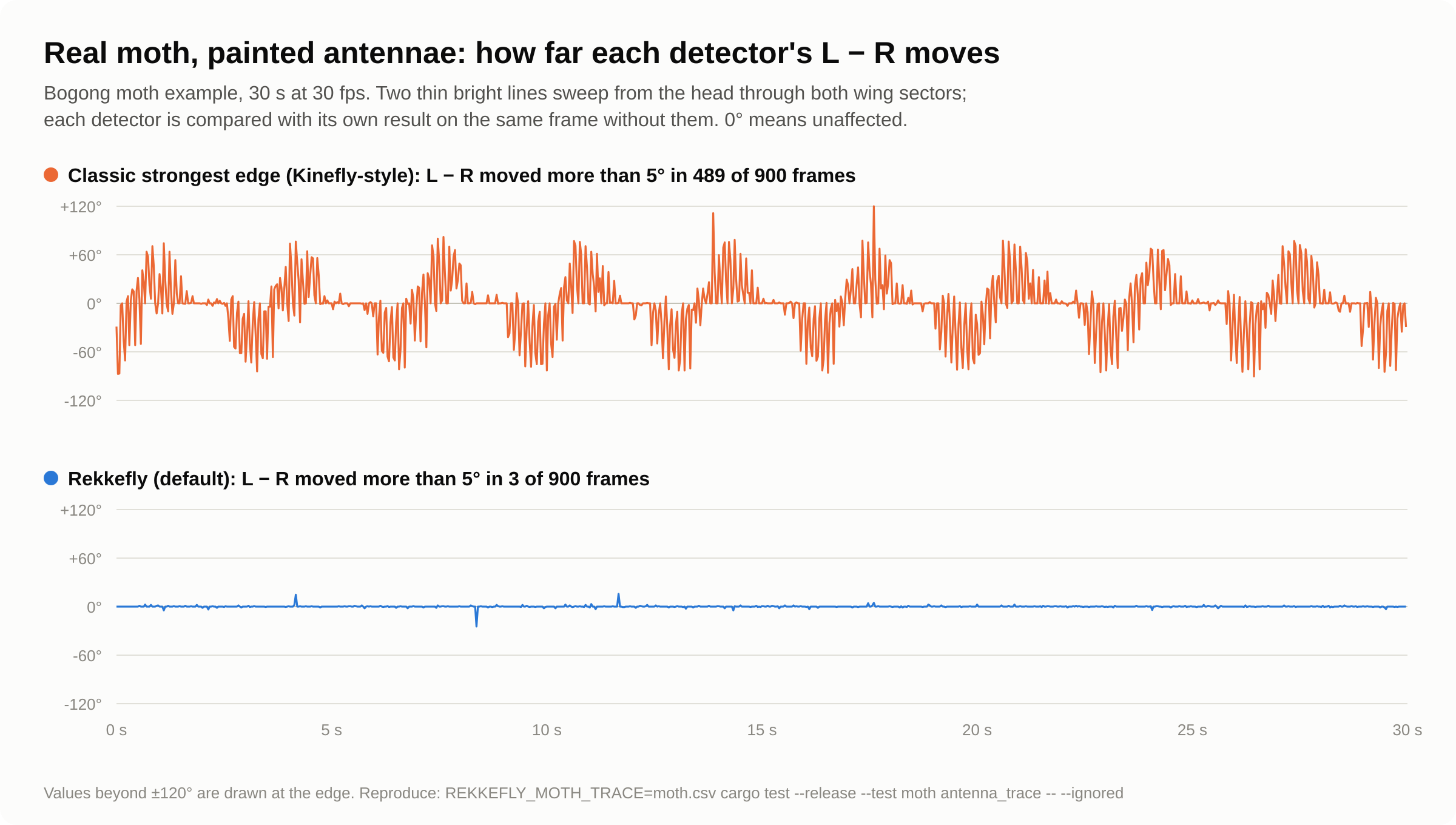
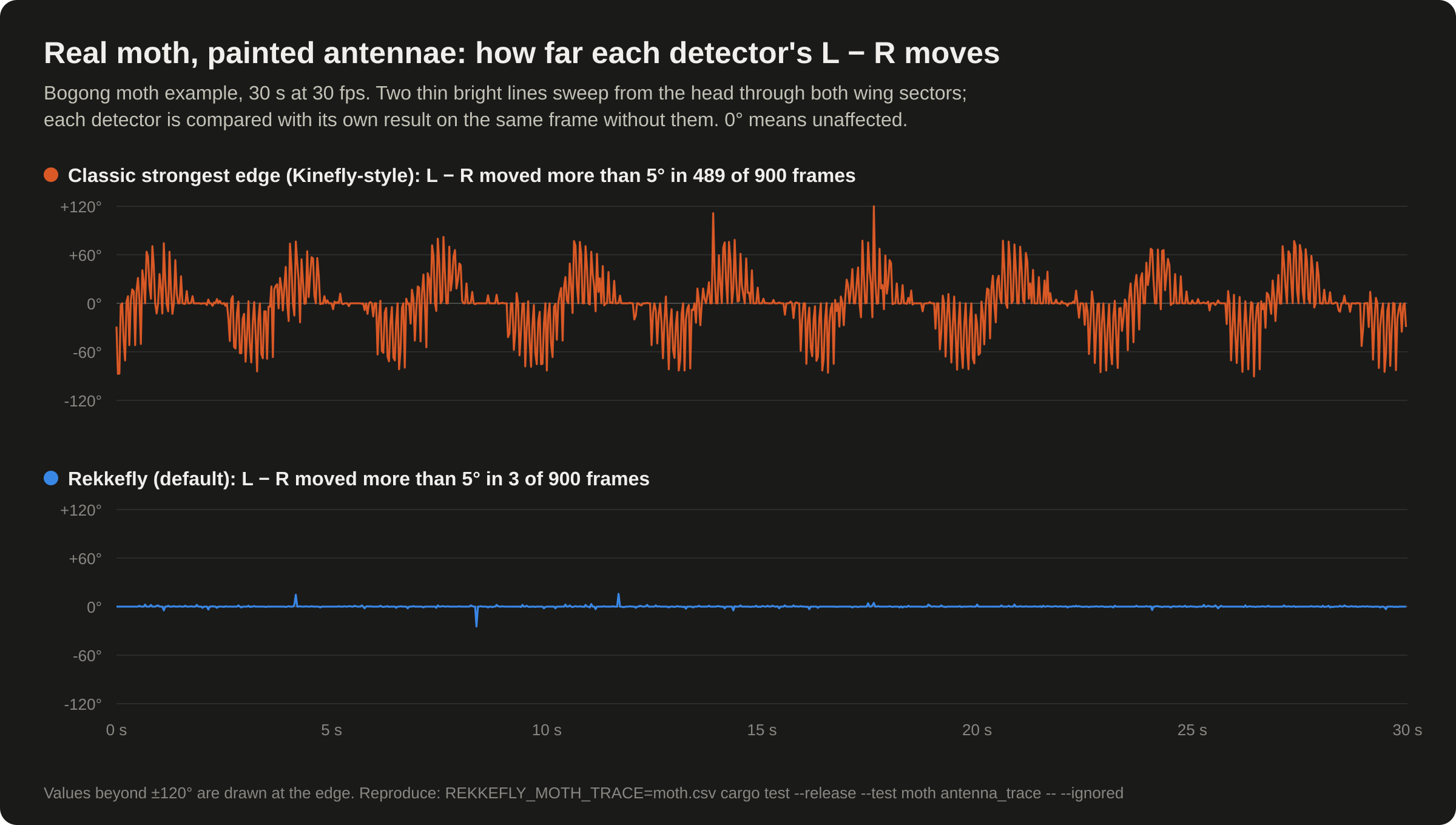
Two thin bright lines, like antennae, were painted onto every frame of the Bogong moth example. They start at the head and sweep through both wing sectors over time. Each detector is compared with its own result on the same frame without them:
| Real Bogong moth, 900 frames | Classic: L − R moved > 5° | Rekkefly: L − R moved > 5° |
|---|---|---|
| Antennae 2 px wide, gray 150 | 489 | 3 |
| Antennae 3 px, gray 200 | 623 | 3 |
| Faint antennae 1.5 px, gray 110 | 315 | 2 |
| Legs 5 px wide, gray 170 | 632 | 8 |
Image perturbations (every third frame, 300 frames): Rekkefly’s L − R moved by more than 5° on at most 2 frames in every case.
| Perturbation | Classic | Rekkefly |
|---|---|---|
| Darker by 25% | 2 | 2 |
| Brighter by 30% | 1 | 0 |
| Sensor noise, σ = 4 | 20 | 0 |
| JPEG recompression at quality 40 | 11 | 2 |
| Blur, σ = 1.5 px | 11 | 1 |
Without perturbations, Rekkefly’s L − R spreads less (sd 11.1° against 14.4° over the whole clip), and left and right agree better (correlation 0.94 against 0.86 over 300 frames).
cargo test --release --test moth -- --ignored --nocapture
A painted antenna is a controlled stand-in: because it is drawn onto real frames, each detector can be compared with itself on the same frame without it. There is no ground truth for the moth’s wing angles, so accuracy on real footage is shown by robustness, stability and agreement between the wings.
On synthetic flies with known angles
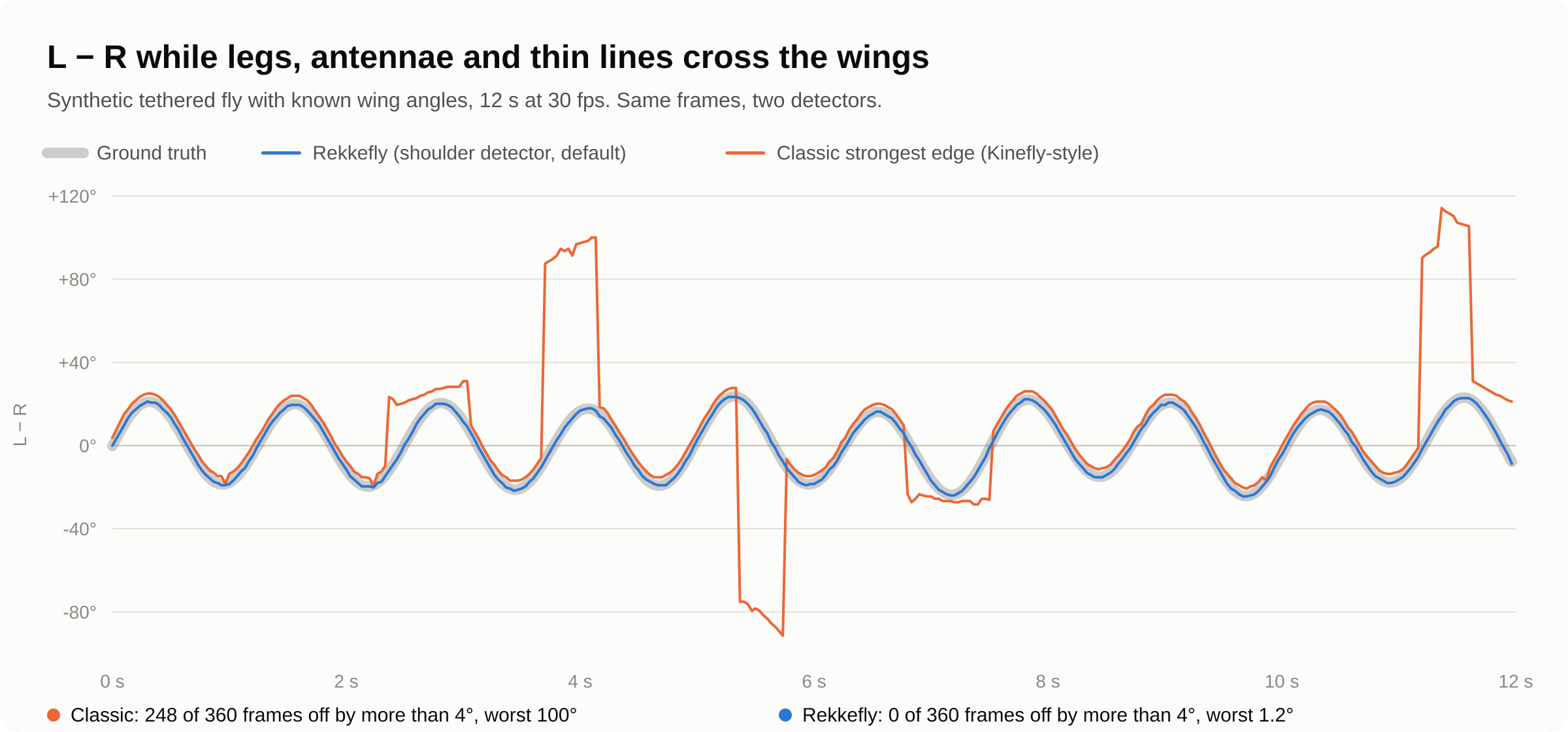
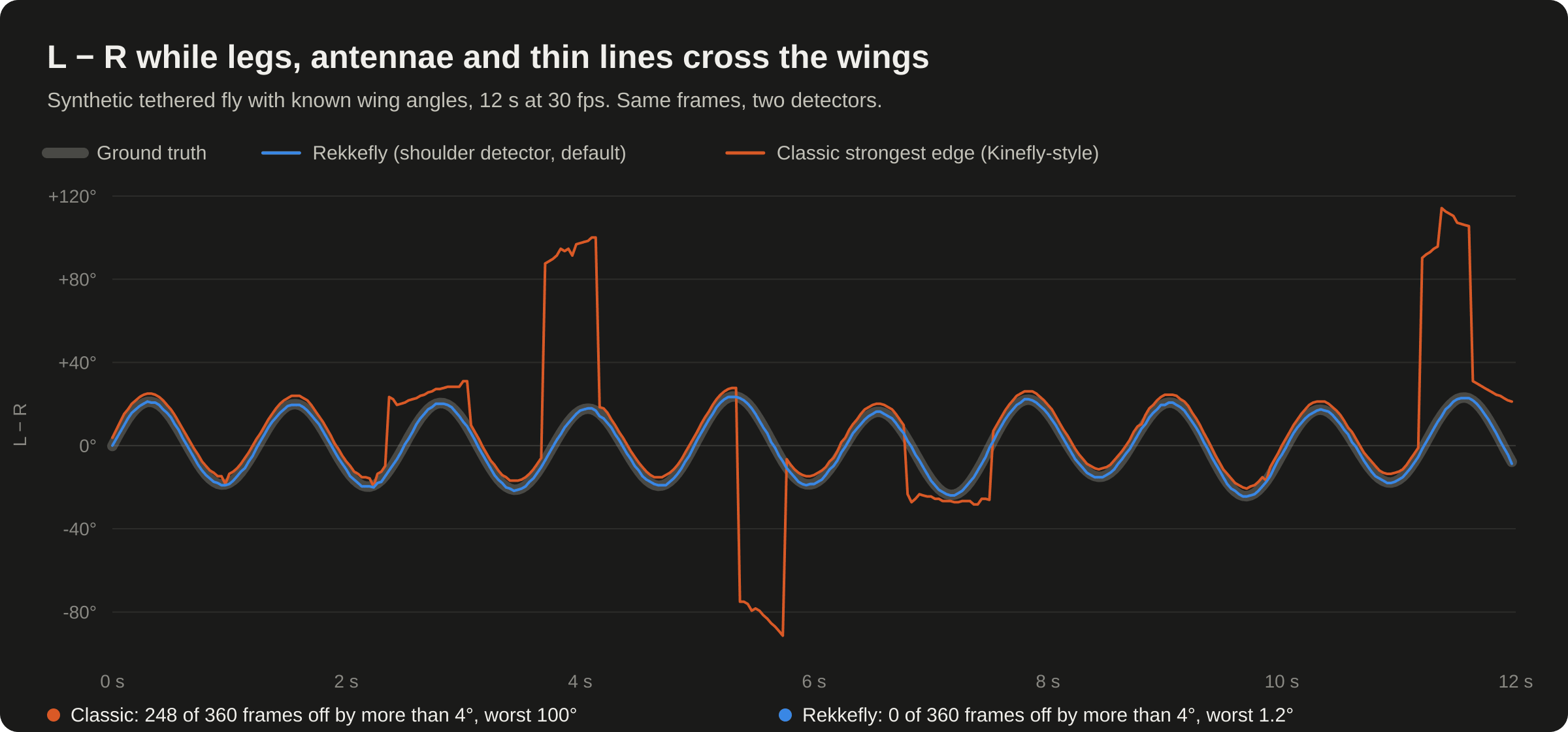
tests/intrusions.rs renders backlit tethered flies with translucent stroke
envelopes, antennae and six segmented legs, with known leading-edge angles. In
some scenes the legs kick through the wing sectors or reach forward in front of
the leading edge; in others, narrow lines drift in and out of the blur.
| Scene, 640×480 (wing measurements) | Classic: off by > 4° | Rekkefly: off by > 4° | Classic: worst L − R error | Rekkefly: worst L − R error |
|---|---|---|---|---|
| Clean flight | 0 / 720 | 0 | 0.6° | 0.6° |
| Legs kicking through the wings | 108 / 720 | 0 | 107° | 0.6° |
| Front legs reaching forward | 720 / 720 | 0 | 116° | 0.6° |
| Six narrow lines as dark as the wing blur, drifting in and out of it | 0 / 600 | 0 | 1.3° | 1.2° |
| Six narrow lines twice as dark | 51 / 600 | 0 | 73° | 1.5° |
| A line hugging one wing’s leading edge, 3° outside | 219 / 600 | 0 | 4.6° (biased in 175 of 300 frames) | 0.8° |
| A line 4° inside the blur | 223 / 600 | 0 | 5.6° | 0.6° |
| Faint wings (7% contrast), 10 lines and kicking legs | 90 / 600 | 0 | 101° | 1.5° |
The results hold at 320×240 and 1280×960, with or without background subtraction, and for legs up to 7× thicker. The median angle error stays near 0.25°.
cargo test --release --test intrusions -- --ignored --nocapture
Where it still fails. Out-of-focus lines wider than the 5° filter: with 12 px lines, 71 of 480 wing measurements were off by more than 4° (worst 34°). Ranking by steepness alone gave 158 (worst 79°).
What has not been verified
- Fly footage with known angles, and recordings from your own rigs.
- Physical cameras on each operating system: development had no camera
attached, and CI has none. Please confirm
rekkefly --list-camerasanddevice = "auto"on your rig.
The full record of what was checked for each release is the Validation report.