Performance
Rekkefly is fast enough that tracking is never the bottleneck of a rig: a camera at 30 fps uses about 6% of one core.
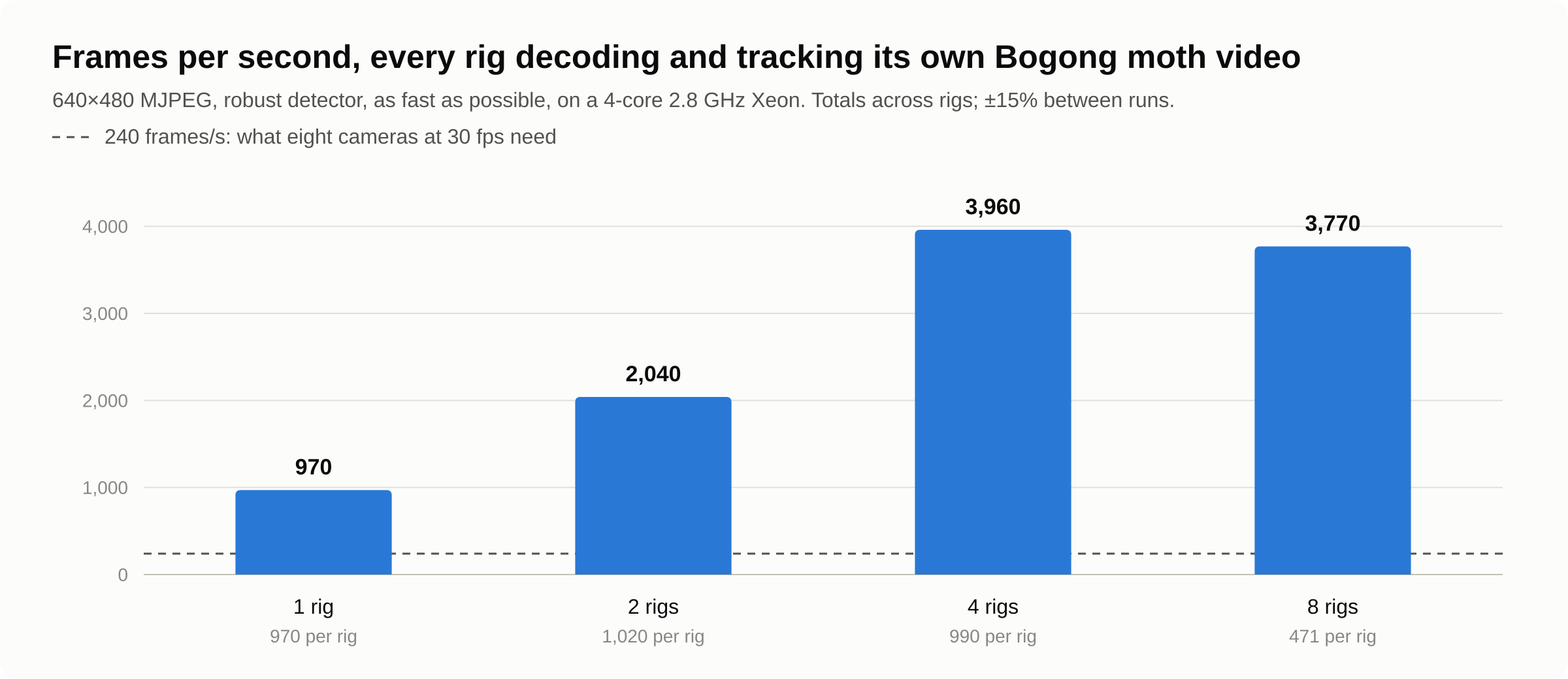
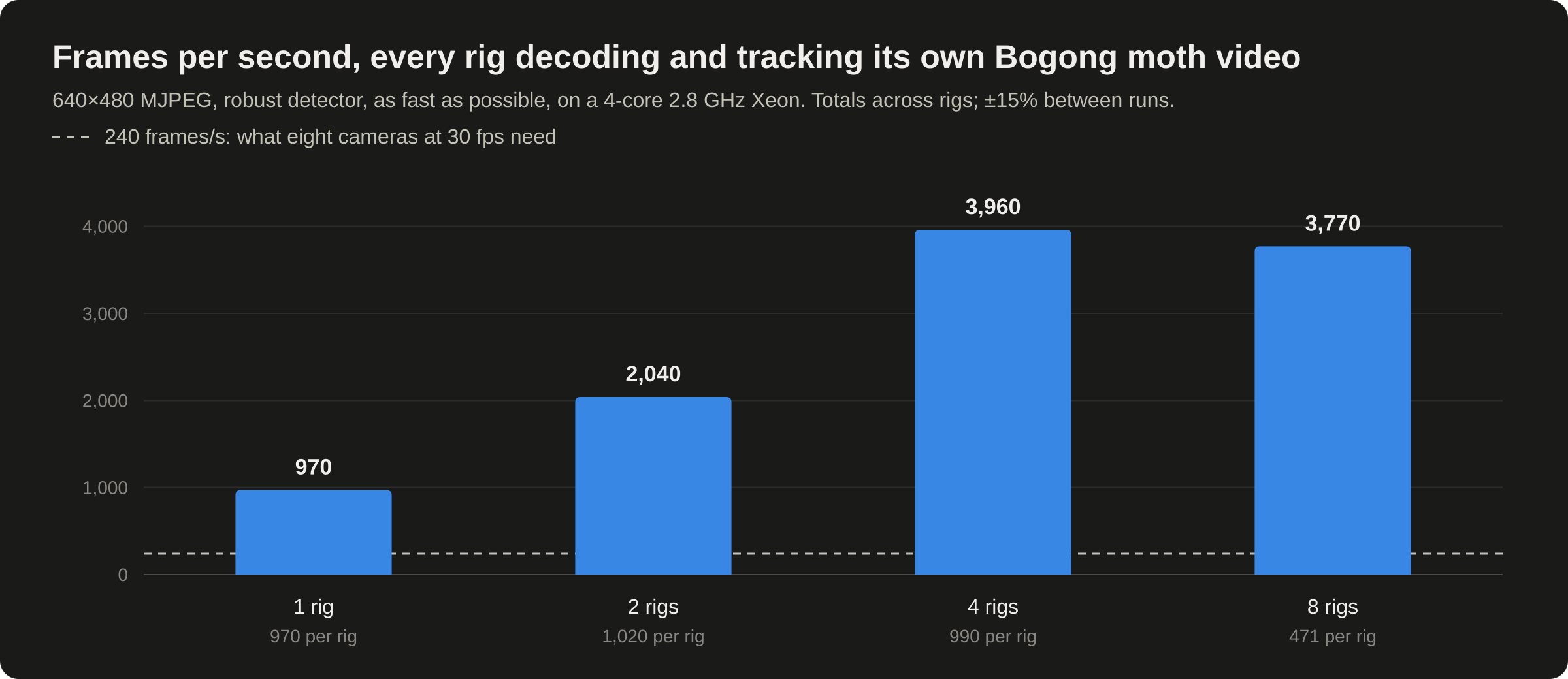
Measured on a 4-core 2.8 GHz Xeon cloud machine, 640×480, both wings at 240 × 72 samples:
| Rekkefly 0.6 | |
|---|---|
| Tracking one frame, robust detector (moth) | ≈ 340 µs (99% under 0.7 ms) |
| Tracking one frame, classic detector (moth) | ≈ 210 µs |
| Video, one rig, MJPEG decoding included | ≈ 800–1,000 frames/s |
| Several rigs at once, totals | ≈ 2,000 frames/s for two, 3,500–4,000 for four or eight |
| One rig at 30 fps, real time | 6% of one core, 10 MB of memory |
| Program size (Linux) | 14 MB, one file |
Against the previous version, on a synthetic 640×480 frame:
| Detector | 0.5.1 | 0.6.0 |
|---|---|---|
Robust (wing_blur) | ≈ 600 µs/frame | ≈ 310 µs/frame (≈ 3,200 frames/s) |
Classic (edge) | ≈ 240 µs/frame | ≈ 235 µs/frame |
Why it is fast
- Tracking runs on each rig’s capture thread, as soon as a frame arrives. There is no queue between the camera and the tracker to add latency.
- No frame copies. Each sector is sampled once per frame from precomputed bilinear positions. Inversion and background subtraction are applied while sampling, not to a copy of the frame. The positions are rebuilt only when the geometry changes, not when a threshold moves.
- Recording is off the capture path. The capture thread hands each frame to encoder threads, which run in parallel only when frames queue up.
- The GUI only draws. The preview refreshes at
preview_fps; tracking uses every frame regardless. - Native code. Rust, compiled for each platform, with SIMD JPEG decoding and encoding.
What costs time
Tracking time grows with the number of samples per sector,
angle_bins × radial_samples, and with the number of enabled parts. The robust
detector takes about 30–60% longer than the classic one, for its bands,
filtering and ranking. Frame size matters only for decoding and recording: tracking samples
the same number of points whatever the resolution.
Measure your own
rekkefly --config my-rig.toml --benchmark --frames 5000   # tracking only, synthetic frame
rekkefly track my-recording.avi --config my-rig.toml      # decoding + tracking
cargo test --release --test moth throughput -- --ignored --nocapture   # 1, 2, 4, 8 rigs
--benchmark measures processing only (foreground preparation and tracking),
without capture, the GUI or outputs, and does not open a camera. Each
measurement also carries processing_us, the tracking time of that frame, so
live performance can be logged too.